
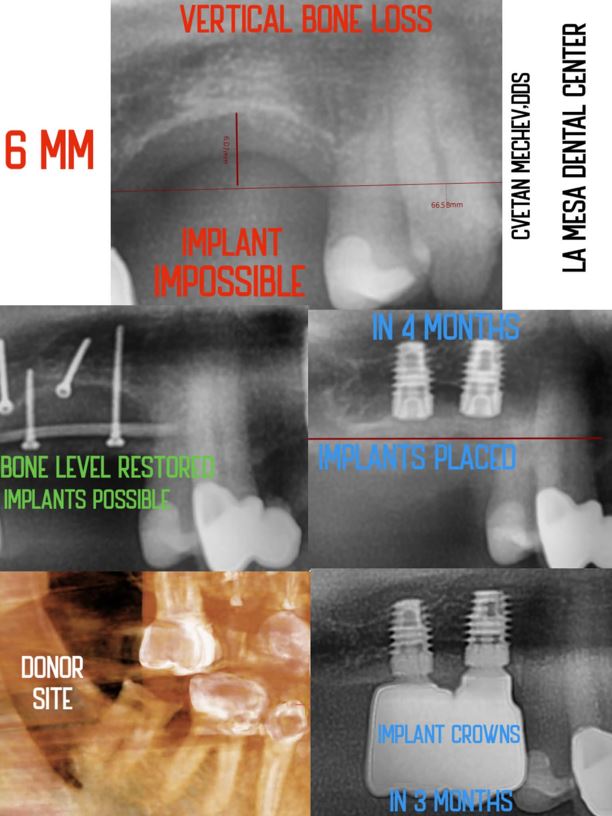
Some patients are told dental implants are impossible for them. Case #5 shows why that is often not the final answer. This patient came to La Mesa Dental Center with a deep vertical bone defect — 6 mm of bone loss. There was simply not enough bone to hold an implant.
Dr. Cvetan Mechev, DDS, with 26 years of experience, rebuilt the missing bone using 100% autogenous bone — the patient’s own bone. Four months later, two dental implants were placed. Three months after that, the final implant crowns were delivered. From “implant impossible” to a complete, functional smile.
The Problem: 6 mm of Vertical Bone Loss
The CBCT scan told a clear story:
- 6 mm — BEFORE augmentation: a deep vertical bone loss defect, far below the level needed to place an implant safely
Vertical bone loss is one of the hardest problems in implant dentistry. When the jaw loses height, an implant has nothing to anchor into. Many offices turn these cases away. At La Mesa Dental Center, this is exactly the kind of case Dr. Mechev treats as part of his vertical bone ridge augmentation work — the “Large volume bone augmentation for dental implants” series.
The Treatment: 100% Autogenous Bone Regeneration
Dr. Mechev rebuilt the defect using only the patient’s own bone. No synthetic materials. No donor bone from a bank.
The bone was harvested from the area behind the lower molars — a safe donor site that heals fully in 6 months. The graft was then shaped to fit the defect and secured with fixation screws. This gave the body a stable framework to regenerate solid, living bone.
Why does this matter? Autogenous bone is still considered the gold standard in bone grafting for dental implants. It contains the patient’s own living cells and growth factors, so it integrates predictably and supports implants for the long term.
The Timeline: Implants in 4 Months, Crowns in 3 More
Here is how the full case unfolded:
- Day 1 — Bone grafting: the 6 mm vertical defect was rebuilt with 100% autogenous bone, secured with fixation screws.
- 4 months — Implants placed: the recipient site healed, the bone level was restored, and two dental implants were placed.
- 7 months — Dental Implant Crowns completed: three months after implant placement, the final implant crowns were delivered.
In about seven months, the patient went from being told implants were impossible to chewing on two fully restored teeth. Every step was planned and verified with our in-house CBCT scanner, so nothing was left to guesswork.
Why Patients Choose Dr. Mechev for Complex Bone Grafting
 Dr. Mechev has trained internationally in advanced bone grafting in Dubai (UAE), London (UK), Padua (Italy), and Budapest (Hungary). He’s one of the only dentists in San Diego and California who trained twice in Padua under Dr. Luca De Stavola, learning the Safecut method — a computer-guided bone harvesting for bone grafting for dental implants way to take bone from one part of the jaw and use it to rebuild another area before placing a dental implant. This training covers both widening a thin jaw (horizontal grafting) and building up a short jaw (vertical grafting).
That level of training is why patients come to La Mesa Dental Center not only from across San Diego County, but some even travel from Arizona and Nevada for large-volume bone grafting and dental implants.
Part of a Documented Case Series
Case #5 belongs to our ongoing, fully documented bone augmentation series. Each case is tracked with real CBCT imaging from the first scan to the final crown. You can see the next case in the series here: 3mm to 10mm Horizontal Bone Augmentation for Dental Implants: Case #6, or browse all cases on our blog.
Frequently Asked Questions
Can dental implants be placed after severe vertical bone loss?
Yes, in many cases. Vertical bone loss can be rebuilt with bone augmentation. In Case #5, a 6 mm defect was regenerated with the patient’s own bone, and two implants were placed just 4 months later.
How long does the full process take, from bone graft to final crowns?
In this case, about seven months. The grafted site healed in 4 months, implants were placed, and the final crowns were delivered 3 months after that.
Where does the bone for the graft come from?
From the area behind the patient’s own lower molars-the area where the wisdom teeth used to be. This donor site heals fully in 6 months and leaves no visible change to the face or smile.After complete healing the dentist-Dr Mechev can go there again and harvest bone to perform bone grafting for dental implants in another area of the mouth if needed.
Is the patient’s own bone better than synthetic bone?
Autogenous bone — the patient’s own bone — is widely considered the gold standard. It contains living cells and growth factors, which helps the graft integrate predictably and support implants long term.
Do patients travel from outside California for this procedure?
Yes. While most of our patients come from La Mesa, El Cajon, Spring Valley, Lemon Grove, and San Diego, some patients travel from Arizona and Nevada for Dr. Mechev’s advanced bone grafting expertise.
Rebuild Your Bone. Restore Your Smile.
If you’ve been told you don’t have enough bone for dental implants, get a second opinion from a dentist who rebuilds bone every week. Dr. Mechev serves patients across La Mesa, El Cajon, Spring Valley, Lemon Grove, San Diego, and Southern California.
Call (619) 337-2424 or request an appointment online.
La Mesa Dental Center · 8334 University Ave, La Mesa, CA 91942