
Bone Grafting for Dental Implants · La Mesa, San Diego
Bone Grafting for Dental Implants in La Mesa
Dr. Cvetan Mechev, DDS brings 26 years of clinical experience to bone grafting for dental implants — rebuilding insufficient jawbone with 100% autogenous bone so patients who were told “no” elsewhere can still qualify for implants.

What Is Bone Grafting for Dental Implants?
Bone grafting for dental implants is a surgical procedure that restores missing jawbone and stimulates new bone growth, creating a strong foundation for an implant. Dr. Cvetan Mechev, DDS performs bone grafting for dental implants at La Mesa Dental Center, 8334 University Ave, La Mesa, CA 91942, serving patients throughout La Mesa, El Cajon, Spring Valley, Lemon Grove, San Diego, and Southern California.
Dental implants replace missing teeth by surgically embedding an artificial tooth root into the jawbone and capping it with a prosthetic tooth. An adequate jawbone is one of the most important factors in a successful implant outcome — when a patient doesn’t have enough bone in the treatment area, bone grafting rebuilds it first.
Dr. Mechev is a member of the American Academy of Implant Dentistry (AAID) and has 26 years of clinical experience performing bone grafting for dental implants in La Mesa and throughout San Diego County.
Types of Bone Grafts
There are four types of bone grafts, each using a different source material to rebuild the jaw and accommodate a dental implant.
Autogenous Graft
Bone harvested from the patient’s own body. This is the gold-standard material Dr. Mechev uses for most cases, since it eliminates the risk of immune rejection and provides a natural scaffold for new bone growth.
Allograft
Lab-processed human bone taken from a bank of donated tissue, used when additional graft volume is needed alongside the patient’s own bone.
Xenograft
Bone grafting material taken from an animal source (commonly bovine), often layered over an autogenous graft to help preserve the rebuilt bone width long-term.
Alloplastic Graft
Synthetic graft material used to replace missing bone in select cases where natural graft sources aren’t appropriate.
Two Approaches to Bone Grafting for Dental Implants
The right technique depends on whether the bone deficiency is in width, height, or both. Dr. Mechev evaluates this with a CBCT/CT scan before recommending a treatment plan.
Horizontal Bone Grafting
Dr. Mechev uses 100% autogenous bone, harvested from the area behind the lower molars, to widen a deficient jaw ridge up to the 7mm minimum width required for stable implant placement, with healing typically taking about 4 months. Horizontal bone loss reduces ridge width, which can leave too little bone to anchor an implant safely. Read the full horizontal bone grafting page for case details and CBCT imaging.
Vertical Bone Grafting
Dr. Mechev rebuilds jawbone height — up to the 10mm minimum needed for implant placement — using the computer-guided Safecut technique and the patient’s own bone. Vertical bone loss reduces ridge height, which can affect both implant stability and the esthetics of the final restoration. Read the full vertical bone grafting page for case details.
How a Bone Graft Procedure Works
The jawbone and teeth have a symbiotic relationship: the jawbone holds teeth in place, and the forces generated by chewing stimulate bone growth. When a tooth is lost and not replaced, the jawbone beneath it begins to deteriorate. Injury, advanced gum disease, root fracture, and other factors can also leave a jawbone too thin or short to support a dental implant.
A bone graft begins with a small incision in the gum to expose the bone beneath. The graft material is placed and the incision is stitched closed. Over the next several months, the graft stimulates new bone growth, creating a stronger foundation for the implant. Local anesthesia is sufficient for most patients; those who experience higher dental anxiety may opt for oral or IV sedation.
Documented Bone Grafting Cases
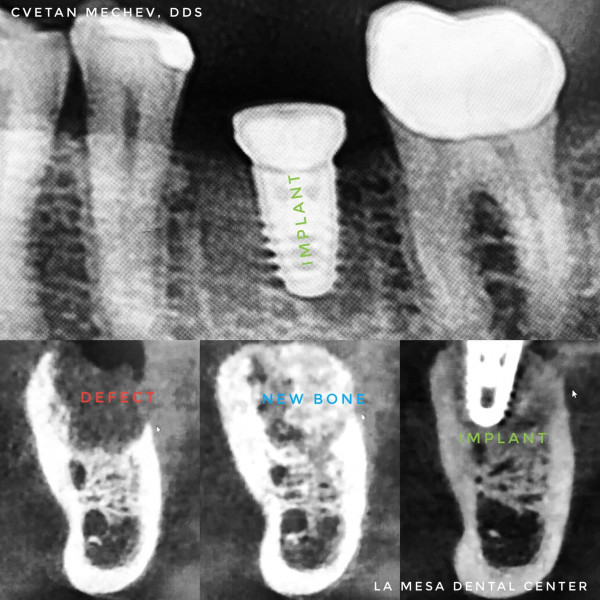
Dr. Mechev publishes detailed, CBCT-imaged case studies for bone grafting for dental implants.
Case #9 — Vertical Bone Augmentation
- Result: 6mm of new bone height achieved
- Technique: Computer-guided Safecut
- Graft material: 100% autogenous bone
Case #10 — Horizontal Bone Augmentation
- Result: 5mm of new bone width achieved
- Graft material: 100% autogenous bone
Recovery After a Dental Bone Graft
For non-smokers in good general health, healing from bone graft surgery is generally straightforward. Initial soreness from the incision typically lasts only a few days and can usually be managed with over-the-counter pain medication. Building enough new bone to support an implant takes longer — typically around 4 months. Following post-operative instructions closely helps optimize healing time and reduce the risk of complications. Once Dr. Mechev confirms sufficient bone growth on follow-up CBCT imaging, implant placement can proceed.
Want the full step-by-step picture? See our bone graft healing timeline, from your first CBCT scan through recipient- and donor-site healing to your final crown.
When Bone Regeneration Is Needed for Larger Defects
In cases where bone loss is more extensive, guided tissue and bone regeneration may be recommended alongside grafting to rebuild both bone and the surrounding soft tissue. This is often combined with a CBCT/CT scan to precisely map the deficient area before treatment. Once your bone has been rebuilt, the next step is typically placement of your dental implant.
Bone Grafting for Dental Implants FAQs
How much bone width and height are needed for a dental implant?
Most dental implants require a minimum bone width of 7mm and a minimum bone height of 10mm. If a CBCT/CT scan shows less than either threshold, bone grafting for dental implants is typically recommended before implant placement.
How long does healing take after a bone graft?
Healing time for bone grafting for dental implants is typically about 4 months before the site is ready for implant placement, depending on the size of the graft and individual healing factors.
What is the difference between horizontal and vertical bone grafting?
Horizontal bone grafting rebuilds the width of the jaw ridge, while vertical bone grafting rebuilds its height. Dr. Mechev determines which approach (or both) is needed based on CBCT imaging of the deficient area.
Where does the bone graft material come from?
Dr. Mechev frequently uses 100% autogenous bone, harvested from the patient’s own jaw in the area behind the lower molars, for bone grafting for dental implants. Other graft sources, including donor (allograft), animal-derived (xenograft), or synthetic (alloplastic) materials, may be used depending on the case.
Is bone grafting for dental implants painful?
Most patients manage the procedure comfortably with local anesthesia. Patients with higher dental anxiety can opt for oral or IV sedation. Post-operative soreness is generally mild and manageable with over-the-counter pain medication.
Serving Patients Across San Diego County
La Mesa · El Cajon · Spring Valley · Lemon Grove · San Diego · Southern California