
Periodontal disease is a quiet but destructive oral health problem caused by bacteria in the mouth. Severe gum disease can cause a loss of gum tissue and bone structure, resulting in lost teeth and even changes to the shape of your face. With proper care and the right treatments, however, it is possible to regrow some of the hard and soft tissues lost to periodontal disease. This is especially important if you’re considering dental implants, which cannot be placed
without sufficient jawbone volume and density. Guided tissue bone regeneration surgery can help repair and rebuild your gums and bones, restore your oral health, and give you something to smile about. What Causes Bone Loss in Teeth?
What is guided bone regeneration?
Guided bone regeneration (GBR) is a bone grafting technique that helps to correct degeneration in the jawbone and create a stable foundation for dental implants. GBR involves the use of a membrane barrier over the grafting site in order to prevent the faster-growing soft connective tissues from interfering with the slower bone regeneration process.
What are the symptoms of bone loss?
- Loose teeth
- Shrinking gums
- New gaps between your teeth
- Bad breath
- Pain when chewing
- Swollen or bleeding gums
Guided bone regeneration for large defects at La Mesa Dental Center
Bone regeneration for large defects can be difficult and unpredictable, but at La Mesa Dental Center, Dr. Mechev is able to perform the procedure safely and precisely with the use of advanced technology involving CT scan and Safecut, an innovative computer guided software. The autograft material (bone harvested from the patient’s own body) is most effective in bone regeneration, and Safecut improves the safety, predictability and simplicity of the harvesting procedure. Safecut allows Dr. Mechev to safely harvest large bone grafts using surgical guides fabricated from CT imaging. In Dr. Mechev’s skilled and highly experienced care, the GBR procedure has a high success rate, and it leads to a significantly increased quality of life for those able to support dental implants.
Is guided tissue regeneration necessary?
Healthy bones and healthy gums are important for the success of dental implants and long-term oral health. Guided tissue regeneration is often a necessary part of restoring the health of the bone and connective tissues when correcting bone and soft tissue degeneration from gum disease.
How does guided tissue regeneration work?
Guided tissue regeneration works by using a membrane to block the faster growing soft tissue cells from growing into the spaces meant for bone regrowth. When bacteria from periodontal disease gets trapped under the gums, it begins to break down the hard and soft tissues, which results in gaps between the teeth and bones. Guided tissue regeneration with bone graft can be used to reverse this process. Grafting material is used to stimulate bone growth, and GTR allows the healthy connective tissues to grow without interfering with the process.
Computer Guided Harvesting of Large Amounts of bone to treat large bony defects for Horisontal and Vertical Ridge Augmentation for Dental Implants.
Guided tissue regeneration vs bone graft
Guided tissue regeneration (GTR) and bone graft often go hand in hand. The bone graft is the material and technique responsible for stimulating bone growth. Guided tissue regeneration is a technique that helps to keep the soft tissues from filling in the space before the slower-growing bone can fill it. The two techniques are often used together for the treatment of bone and gum deterioration from periodontal disease. There are many cases, however, when GTR is done without bone grafting material.
Is guided tissue regeneration necessary?
Healthy bones and healthy gums are important for the success of dental implants and long-term oral health. Guided tissue regeneration is often a necessary part of restoring the health of the bone and connective tissues when correcting bone and soft tissue degeneration from gum disease.
How does guided tissue regeneration work?
Guided tissue regeneration works by using a membrane to block the faster growing soft tissue cells from growing into the spaces meant for bone regrowth. When bacteria from periodontal disease gets trapped under the gums, it begins to break down the hard and soft tissues, which results in gaps between the teeth and bones. Guided tissue regeneration with bone graft can be used to reverse this process. Grafting material is used to stimulate bone growth, and GTR allows the healthy connective tissues to grow without interfering with the process.
Case. Dental implant possible with a new bone.
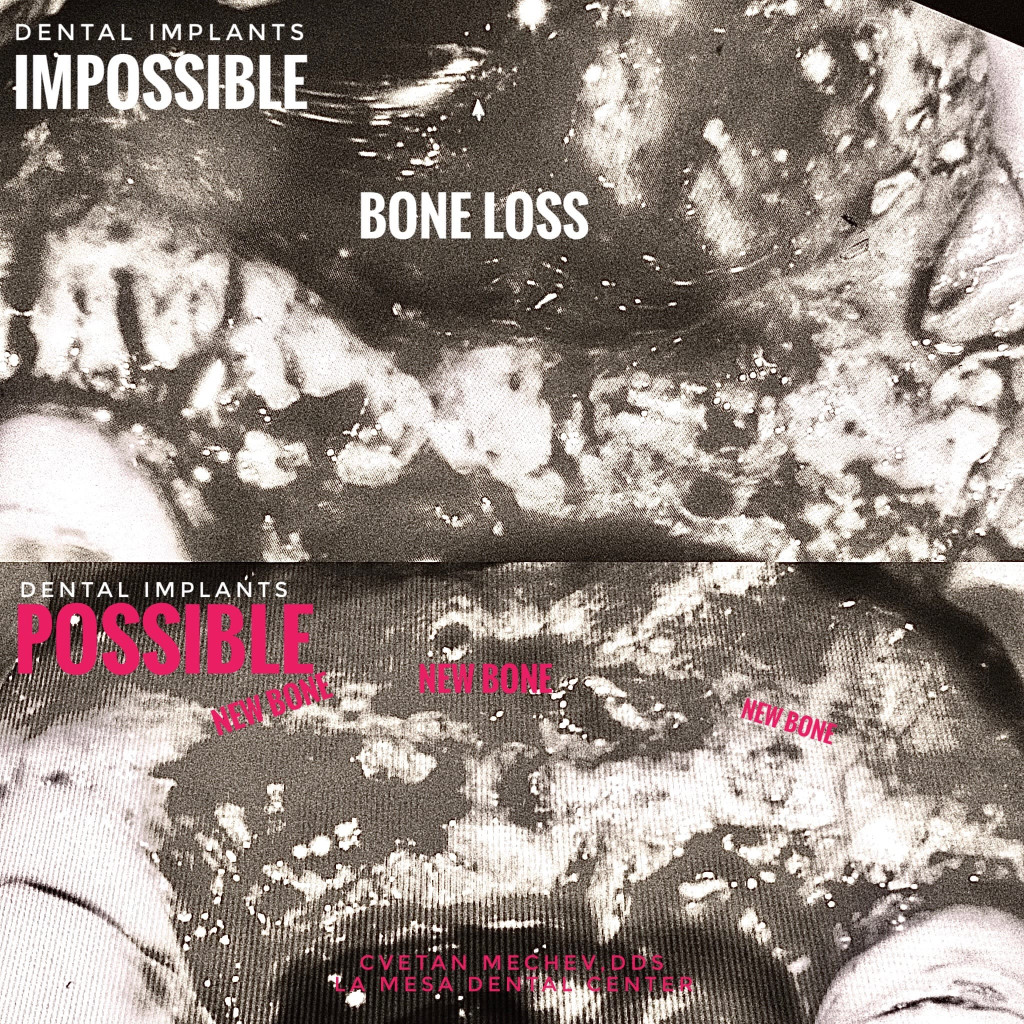
Case. Before and after jaw bone loss reversal
Deep and large bone loss defect treated with 100% autogenous ( from the patient) bone. Large volume horisontal bone regeneration for dental implants will allow the patient to have anterior individual teeth.
The Safecut procedure is covered by a signed patent from Dr.Luca De Stavola and Dr.Andrea Fincato. Dr Mechev is the only dentist in San Diego and one of the only 3 US dentists that have completed the 3 days Safecut surgical training on the procedure in Padova, Italy.
What Is Autogenous Bone Harvesting?
Autogenous bone harvesting is a surgical procedure that involves removing bone from one part of a patient’s body and transplanting it to another area. This procedure is typically done by Dr Mechev with local anesthesia only, and the bone can be harvested safely from the corner of the mandibular/lower jaw- the area of the wisdom teeth . Once the correct size bone block is harvested , it is usually split into 2 thin bone pieces/plates .Those 2 bone plates are then thinned with a special instrument ( BoneScraper) to minimal thickness of 1 mm. Once the 2 bone plates are prepared they are fixed with stainless steel screws to the recipient site that needs bone grafting into the desired shape. The empty places of the shape is filled with the bone chips collected during the bone plates thinning process.
read more What is autogenous bone harvest for implant reconstruction?
Bone Grafting Augmentation Cases performed by Dr.Mechev
CASE
6 mm Vertical Bone Grafting Augmentation for dental implants.
Bone was harvested with CT guided surgical guide Safecut from the same patient donor site and fixated with 4 screws to the bone defect recipient site.Dental implants will be placed in 4 months.
Can bone regenerate after periodontal disease?
Yes, guided tissue regeneration with bone graft is often used successfully to help regenerate healthy bone and gum tissue after periodontal disease. Adhering to a proper dental hygiene routine and committing to regular visits with your dentist will greatly increase your chances of a successful outcome.
Do dental implants stimulate bone growth?
Yes, dental implants are the only tooth replacement option that stimulates jawbone growth. Teeth roots and jawbones have a symbiotic relationship. The jaw helps to keep the teeth stable and secure, and the pressure from chewing helps to stimulate the growth of the jawbone. By using the implant post to replace the tooth root, dental implants promote jawbone health. No other solution replaces the entire tooth, from root to crown. Dental implants are the best tooth replacement option available.
What happens if I don’t get a bone graft?
If you don’t have sufficient jawbone volume or density to support dental implants, you’ll need a bone graft to ensure their success. If you don’t get a bone graft, the implants may not last, or they might not take hold in your jaw at all. If your dentist says you need a bone graft before implants and you question their opinion, you are always free to get a second one so you feel secure in your ultimate decision.
Do dental implants stimulate bone growth?
Yes, dental implants are the only tooth replacement option that stimulates jawbone growth. Teeth roots and jawbones have a symbiotic relationship. The jaw helps to keep the teeth stable and secure, and the pressure from chewing helps to stimulate the growth of the jawbone. By using the implant post to replace the tooth root, dental implants promote jawbone health. No other solution replaces the entire tooth, from root to crown. Dental implants are the best tooth replacement option available.
What happens if I don’t get a bone graft?
If you don’t have sufficient jawbone volume or density to support dental implants, you’ll need a bone graft to ensure their success. If you don’t get a bone graft, the implants may not last, or they might not take hold in your jaw at all. If your dentist says you need a bone graft before implants and you question their opinion, you are always free to get a second one so you feel secure in your ultimate decision.
Dealing with bone loss in the jaw? Reverse bone loss San Diego, CA
Dental bone regeneration for large defects is an important procedure for individuals who are considering dental implants but do not have enough healthy bone tissue in the jaw to support them. Schedule an appointment with a dental implant expert Dr. Mechev today by calling (619) 337-2424